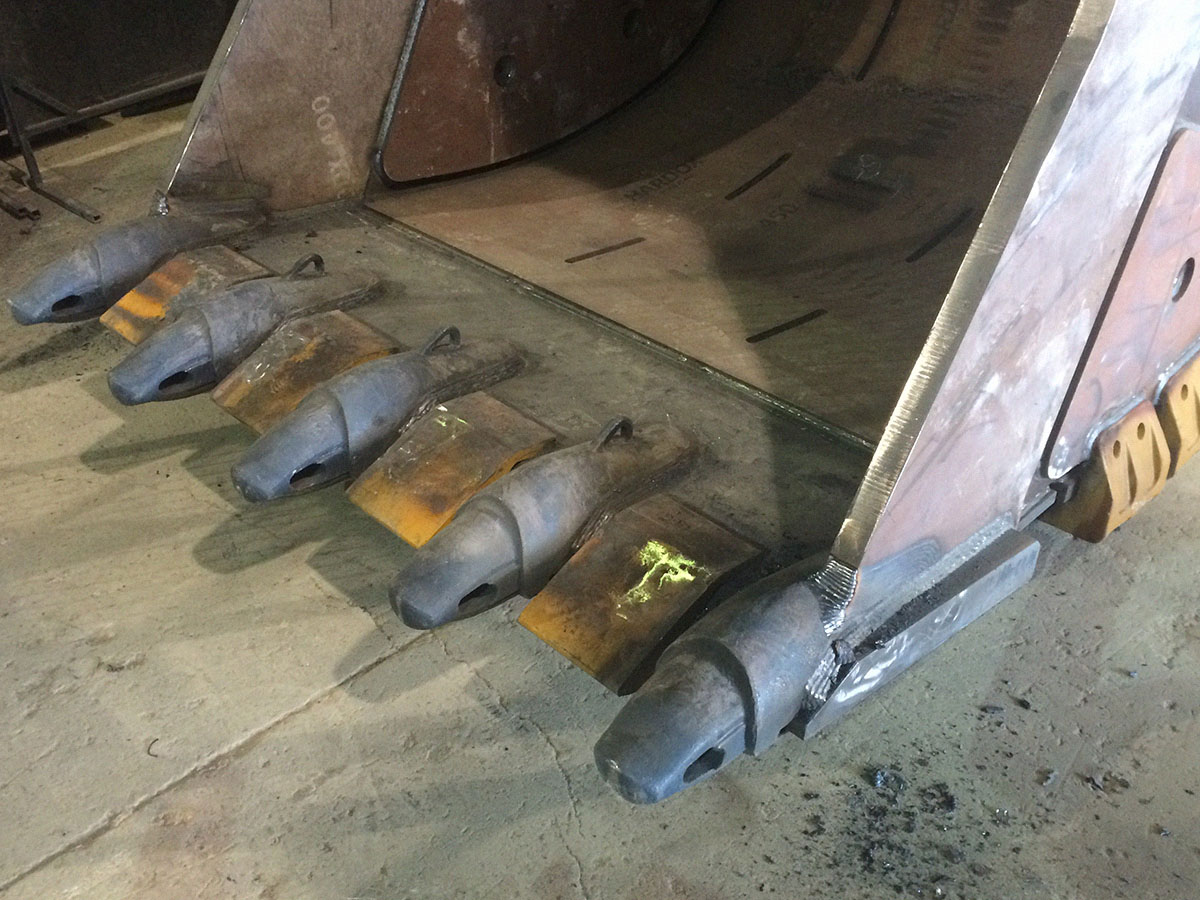
Ground engaging tools, usually shortened to GET, are the parts that touch the ground first. Teeth, adapters, shrouds and cutting edges take the abrasion so the bucket underneath does not have to. They are consumables by design. Every one of them is meant to wear out, and the question on any site is never whether they will, only how fast and whether anyone notices before something expensive gets hurt.
This page is the plain-language version. What the parts are called, where a bucket actually wears, how to read that wear, and what to do once the GET has done everything it can.
The vocabulary, sorted out
The terminology across manufacturers is inconsistent enough to cause real confusion on a parts order, so here is the version that holds up across brands.
Teeth and tips are the points at the leading edge that break into the material. They do the digging and they wear the fastest of anything on the machine.
Adapters are the mounts that hold the teeth to the lip. They wear slower than the teeth but they wear, and a worn adapter is why a new tooth will not seat properly.
Lip shrouds sit between the teeth along the front edge of the bucket lip. They protect the lip itself, which is structural and expensive, by giving the material something cheaper to grind against. → Read our full breakdown of HEX lip shrouds and what they fit
Heel shrouds protect the back corner of the bucket where it drags and pivots. This is the spot operators forget about, because it does not fail dramatically. It just quietly disappears until the bucket corner is gone. → Read our full breakdown of heel shrouds and heel savers
Cutting edges and base edges run along the bottom on loaders and dozers, doing the same job across a flat span rather than at points.
Where a bucket wears
Wear is not even and it is not random. It concentrates in the same places every time.
The leading edge takes the impact and the abrasion together, which is why teeth go first. The corners take a beating out of proportion to their size because that is where the bucket twists into the pile. The heel wears from dragging rather than digging, so it is a slow grinding loss instead of a chipping one. The inside floor and the side walls wear from material sliding across them on every load and dump cycle, and that wear has nothing to do with GET at all, which matters later on this page.
Knowing the pattern is most of the job. A bucket that is wearing somewhere unexpected is telling you something about how it is being run or what it is being run through.
Reading the wear before it costs you
There are a few things worth looking at on a walkaround, and none of them need a gauge.
Tooth profile. A new tooth has a defined point. Once it has gone blunt and square, it is not penetrating anymore, it is pushing. Fuel burn climbs, cycle times stretch, and the operator starts working the machine harder to get the same bucket.
Adapter exposure. If you can see the adapter nose through where the tooth used to be, you are past due and the next failure damages the lip.
Lip visibility. Shrouds are sacrificial. Once they have worn through to the point where bare lip is showing between them, the protection is gone and every hour after that is coming out of the bucket itself.
Heel thinning. Look at the back corner from the side. Rounded off where it should be square means the heel is going.
Loose fits. Anything rattling is wearing its own mount, and the mount is the part that is not supposed to be a consumable.
The rule of thumb that matters: replace the cheap part on a schedule or replace the expensive part on an emergency. GSD® does not happen with a bucket sitting in the shop, waiting on a lip repair that a cheap shroud would have prevented.
Where GET ends and wear protection begins
Here is the part most GET conversations skip.
GET protects the edges. It does nothing for the floor of the bucket, the side walls, the liner surfaces, the chutes, the truck box, or anywhere else material slides instead of digs. That is a completely different wear problem with a completely different answer, and it is the one Raptor spends its days on.
Sliding abrasion across a broad surface calls for wear plate. Wear resistant CCO RaptorPlate® puts a chromium overlay where the material runs, and it lasts through cycles that would eat plain steel. For heavy impact zones where the material is dropping rather than sliding, chocky bars and wear blocks take the hit in a pattern you can replace piece by piece instead of resurfacing a whole panel. Along the edges and corners where a bucket or box takes the worst of it, Rambo™ SideBars carry the load.
Want to see what that looks like in the field? One CCO RaptorPlate® liner package ran five years across four Yukon applications on a single dozer blade, from hard rock copper to road work.
The judgement call between those depends entirely on what your material is doing, and anyone who gives you a definitive answer without seeing the wear is guessing.
→ See the full Raptor wear parts and wear plate range
The short version
GET is the sacrificial layer at the digging edge and it is supposed to wear out. Change it on a pattern you can predict rather than on the day it fails. Watch the tooth profile, the adapter exposure, the lip between the shrouds, and the back of the heel, because those four tell you almost everything.
And when the wear is not at the edge, it is not a GET problem. It is a wear protection problem, and the material choice is where the money either gets saved or gets spent twice.
If you are weighing that choice against what the OEM quoted, our buyer's guide to OEM versus aftermarket wear parts walks through how to evaluate a supplier before the order goes in.
Why Raptor
Raptor Mining Products has been designing and supplying high-performance wear parts and wear protection to mining operations since 2004. With heavy-duty alloys and locally stocked inventory, Raptor delivers on customer expectations in the field, not just on paper.
Get a Quote
Tell us what is wearing and what it is running on, and the Raptor team will come back with options. → Request a quote
Email: raptor@raptormining.com
Toll free: 1-866-972-7867
International: +1-780-444-1284
PEOPLE. SAFETY. QUALITY. VELOCITY.